Croatian
FAQ
What is the difference between WOOLEE fertilizer and manure in organic production?
WOOLEE fertilizer contains a high nitrogen content of 9–12.5% and 5% potassium – MANURE does not reach these values.
WOOLEE nitrogen is slow-releasing because it remains stored in the wool fibers until the accumulated water in the WOOLEE pellet evaporates – MANURE releases nitrogen quickly.
WOOLEE fertilizer is sterilized with WSU 3000 technology, removing all pathogens – MANURE is not sterilized, and we know it is animal waste.
WOOLEE fertilizer does not contain weed seeds – MANURE (being animal waste) contains seeds from the weeds and grasses the animal has eaten.
What is the pH value of WOOLEE fertilizer?
The pH value of our fertilizer is between 8.49 and 8.68.
How much WOOLEE fertilizer should be used in an olive grove?
Around each plant, dig in about two handfuls of WOOLEE fertilizer, depending on the thickness of the trunk. However, you can’t overdose it – using more won’t harm.
Can WOOLEE NPK 9/12.5 – 0 – 5 fertilizer be overdosed?
No, it cannot be overdosed because WOOLEE is an organic fertilizer. NITROGEN (12%) and POTASSIUM are slow-releasing and nourish both the plant and the soil.
There is no phosphorus (P), which in chemical fertilizers binds nitrogen. How to add phosphorus?
There is no need to add phosphorus, because the 12% NITROGEN is stored in the sheep wool fibers of WOOLEE fertilizer, which naturally bind it. Therefore, WOOLEE fertilizer does not require any phosphorus.
Is it better to dig WOOLEE fertilizer into the soil?
Yes, it is better to bury it. WOOLEE pellets act as small water reservoirs, slowly releasing water with nitrogen and potassium, feeding both the soil and plants over a long period.
How to use WOOLEE fertilizer for cabbage, spinach, or tomatoes?
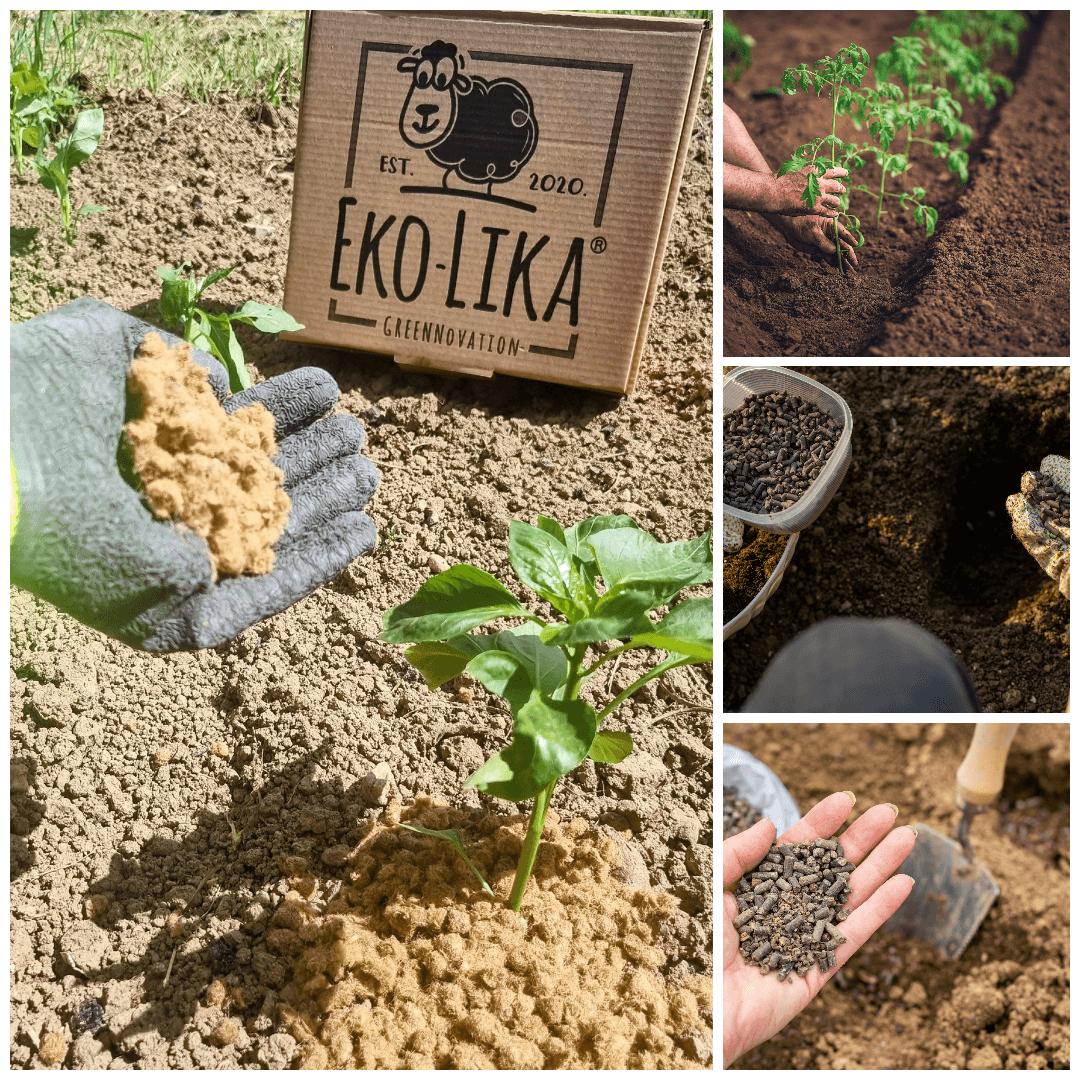
It’s best to sprinkle two tablespoons of WOOLEE pellets into the planting row by hand, cover them with soil, and then plant the seedlings on top.
How long and how do WOOLEE flakes work as protection against pests and slugs?
Sprinkle WOOLEE protective flakes around the plant so that the soil is covered. Because of their hygroscopic properties, the flakes absorb the mucus of slugs and pests, preventing them from moving. The flakes expand and form a protective mat that lasts about 30 days until it decomposes. You can freely add more flakes on top—they also lightly nourish the plant. Safe for children and pets!
Does WOOLEE protection work against all types of slugs?
Yes, WOOLEE protection works against all types of slugs—naked slugs, those with shells, large or small—because the WOOLEE flakes absorb the slug’s mucus. Without mucus, slugs cannot move. After absorbing moisture, the flakes expand and create a protective mat that also acts as mulch.
Is the nitrogen in sheep wool derived from sheep manure, since wool itself has no fertilizing properties? Is that true?
That is not true! Sheep manure contains only 3–5% nitrogen, while sheep wool contains 9–12.5% nitrogen and 5.5% potassium.
Why? Because sheep graze on grass, and through photosynthesis, grass absorbs natural nitrogen and potassium from the air, which the sheep then store in their wool.
Is sterilization necessary for WOOLEE fertilizer and WOOLEE protection?
Yes, it is necessary! Sheep can carry certain diseases that may be transmitted to humans through unsterilized wool, which can contain pathogens, parasites, and ticks.
How much WOOLEE fertilizer should be mixed into the soil per m²?
A 2L package of WOOLEE fertilizer nourishes and fertilizes 10 m² of garden soil if mixed into the soil to improve its structure.
If used for feeding plants directly, press 1–2 tablespoons around each plant. In that case, one 2L package fertilizes about 35 m² of garden area.
For which plants can WOOLEE fertilizer be used?
WOOLEE fertilizer has proven to be an excellent choice for all kinds of vegetables, fruits, and flowers (ornamental plants). Below is a list of plants we have tested with great results. Especially for flowers and ornamentals, this product is unmatched due to its slow-release nitrogen that nourishes plants for up to six months—benefiting not only flowers but also fruits and vegetables!
Vegetables (seasonal crops): Tomatoes, Peppers (sweet and hot), Cucumbers, Zucchini, Lettuce (various types), Cabbage, Kale, Broccoli, Cauliflower, Beans, Onions, Garlic.
Fruit trees (commonly grown in yards): Apple, Pear, Plum, Cherry, Apricot, Peach, Nectarine, Olive (especially in Dalmatia and coastal areas), Fig, Hazelnut, Walnut.
Ornamental plants and shrubs: Roses, Hydrangeas, Lavender (especially in Dalmatia and Istria), Orchids, Oleander (coastal areas), Cypress, Thuja and other conifers (for hedges), Magnolia, Wisteria.
How to use the repellent (eco protection)?
The repellent forms a physical barrier around the plants (seedlings) so that slugs cannot cross and reach them. It is best applied right after rain. If your garden is surrounded by a wall, you can apply the repellent along the wall to enclose the entire garden. One of our customers uses it this way and found it an excellent solution—no need to apply it around each plant individually.
What payment methods are available in the web shop?
You can pay in the following ways:
1. By credit card
2. Cash on delivery (pay when the package is received)
3. Bank transfer (the slowest method, as we ship once the payment is received)
Where can WOOLEE products be purchased physically?
WOOLEE products are available at the following locations across Croatia:
PEVEX stores:
Split – Put Juke 6, Kaštel Sućurac
Zadar – Ulica 159. Brigade 6, Zadar
Rijeka – Kukuljanovo 361, Kukuljanovo
Osijek – Kneza Trpimira 24, Osijek
Pula – Industrijska 15, Pula
Zagreb (Jankomir) – Velimira Škorpika 9, Zagreb
Sesvete – Savska cesta 84, Sesvete
Other partners:
Agroplant d.o.o., Polačka ulica 21, Zadar
Contact: Jerko Modrić – 099/220-7782
Poljopromet d.o.o., Lički Osik 81, 53000 Gospić
Maraš d.o.o., Sales center Zadar – Nikole Jurišića 67, 23000 Zadar
Tel: 023/340-978
Agrocentar Nada d.o.o., Hrastinska 62, 10430 Samobor
Tel: 01/3363-721